Improving the Performance of Bug Report Summarization Using Deep Learning Methods
2024.01 Back to posts
Improving the Performance of Bug Report Summarization Using Deep Learning Methods
🎉 Supported by the 112th Academic Year College Student Research Grant


🎯 Project Overview
Our research focuses on enhancing bug report summarization through deep learning methods. We explore how intent detection can improve summarization performance and investigate various classifiers for optimal results.
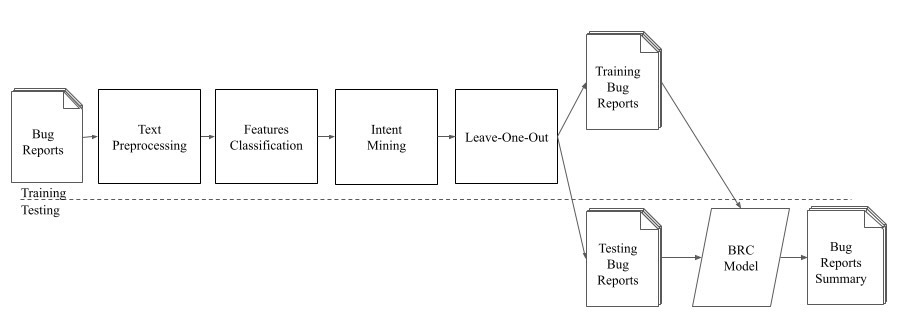
🔬 Methodology
Feature Engineering
We focused on four main feature categories:
- Structure features
- Participant features
- Length features
- Lexical features
Models
- Intent Classification using BRIC model with BiLSTM
- Summarization Models:
- Logistic Regression (LR)
- Random Forest (RF)
- Support Vector Machine (SVM)
- eXtreme Gradient Boosting (XG)
📈 Results
| Model | Precision | Recall | F-score |
|---|---|---|---|
| BRC2014 | 0.428 | 0.453 | 0.440 |
| IBRS | 0.430 | 0.454 | 0.442 |
| BRIC+BRC | 0.432 | 0.451 | 0.441 |
Key Findings
- SVM shows best overall performance in BRC and IBRS models
- Random Forest excels in BRIC+BRC model
- Intent detection improves performance with LR and RF
👥 Contributors
- Students: Chen Kuan-Jung, Tu Chieh-Yu
- Advisor: Yang Cheng-Zen
- Institution: Yuan Ze University, Department of Computer Science & Engineering
For more details and implementation, please visit our GitHub repository.